The visible part of an AI application is often a conversation. Behind that conversation sit less glamorous questions: which document to retrieve, which tool to call, which request needs review, and when enough evidence exists to finish. These small choices determine whether the application feels useful or erratic.
Decision APIs could make those choices a common, reusable part of the software stack. That is a plausible direction of travel, not a claim that every company will launch the same product or that every application needs a model. The strongest opportunity is a shared way to turn messy context into a limited, testable next step.
The opportunity lives between existing components
Consider a purchasing application. It already has a catalog, supplier records, approval rules, and an order service. Employees still send requests such as “something like the monitor in our design room, but suitable for travel.” The application needs to interpret the request before its precise business rules can operate.
A decision layer can identify the product category, detect missing requirements, and select the next information request. Once the evidence is clear, ordinary services can check budgets and inventory. The model adds useful interpretation at the boundary between human language and structured operations.
This suggests a practical adoption pattern. Teams may first add isolated classifications, then reuse successful decisions across interfaces. A purchasing chatbot, a web form, and a mobile workflow could all call the same requirement-triage service. Consistency comes from the shared contract, even when the user experience differs.
The broader forecast depends on economics and reliability. If integration and review costs remain high, many applications will retain simpler rules. Adoption should be judged by useful outcomes, not the number of places where an AI call can technically be inserted.
Model providers are exposing different building blocks
OpenAI announced its Decisions API at DevDay in September 2026. Its documentation, reviewed October 9, describes the service as public beta. This provides direct evidence that bounded decision interfaces are becoming provider products, while its eventual general availability remains a separate milestone.
Anthropic's engineering discussion of agents and workflows distinguishes predefined orchestration from systems where a model dynamically chooses its path. Both patterns contain decisions, but they assign control differently.
For an application builder, the question is where flexibility helps. A workflow can use an AI classification at one point and follow fixed steps afterward. An agent may choose among tools repeatedly as new evidence arrives. A separate Decision API can serve either design.
Provider interfaces should therefore be compared by the role they perform. A general model endpoint, a typed decision endpoint, and a managed agent runtime are related products with different responsibilities. Treating them as interchangeable can obscure which parts of the application the team still needs to build.
Cloud platforms add deployment choices
Microsoft documents automatic and direct model routing in Foundry. A deployment can use a configured router or target a specific model through the Responses API. This illustrates how model selection can become an infrastructure capability.
Oracle's OCI Chat Completions documentation distinguishes its stateless chat interface from its Responses API for richer tool-enabled workflows. Compatibility with a familiar request format does not make authentication, model behavior, or feature availability identical across providers.
An Azure Decision API or Oracle Decision API implementation might therefore refer to an application deployed on that cloud, rather than a product with exactly that name. Clear terminology prevents an architecture description from becoming an inaccurate vendor claim.
Before choosing a deployment path, map the actual data journey. Identify where evidence is retrieved, where inference runs, which services can take actions, and where logs are stored. The best fit depends on the organization's existing systems and operating requirements as much as on a model's capability.

Developer tools show why routing can be invisible
Cursor's model documentation describes an Auto option that selects a model for the task. The user sees a development environment, while model selection occurs within that experience. This is one example of a decision becoming a product capability rather than a separate screen.
The same design could appear in many applications. A document editor might choose whether a request needs retrieval. A service dashboard might decide which evidence to show first. A learning tool might select the next explanation format after a student expresses confusion.
These are product design possibilities, not claims about specific unreleased features. Their common requirement is a decision whose consequences can be observed. If a hidden choice consistently makes the experience worse, the team needs a way to inspect and change it.
A polished interface should reveal what helps the user act: the selected next step, the evidence needed, or the reason a review is required. Detailed model routing metadata usually belongs in the operational view instead.
A shared decision contract can cross the stack
Return to the purchasing example. The website receives a request, the decision service identifies missing specifications, and the application asks a focused follow-up question. When the employee answers, the same service evaluates the updated state. The purchasing policy remains responsible for whether an order can proceed.
Make the returned outcome specific: request_dimensions is easier to interpret than needs_more_information. Include a stable reason code and a record of which evidence was considered. A mobile client can display a short prompt while an internal dashboard shows the full context.
The contract should also distinguish recommending an action from completing it. prepare_order and order_created are different states. A network retry must not turn one approved purchase into several orders.
This architecture creates an opportunity for shared improvements. If the requirement classifier becomes more accurate, every client benefits. It also creates shared responsibility: a defective policy change can affect every caller. Versioning, gradual rollout, and an emergency fallback deserve attention before the service becomes central to the stack.
Local and frontier models can share responsibilities
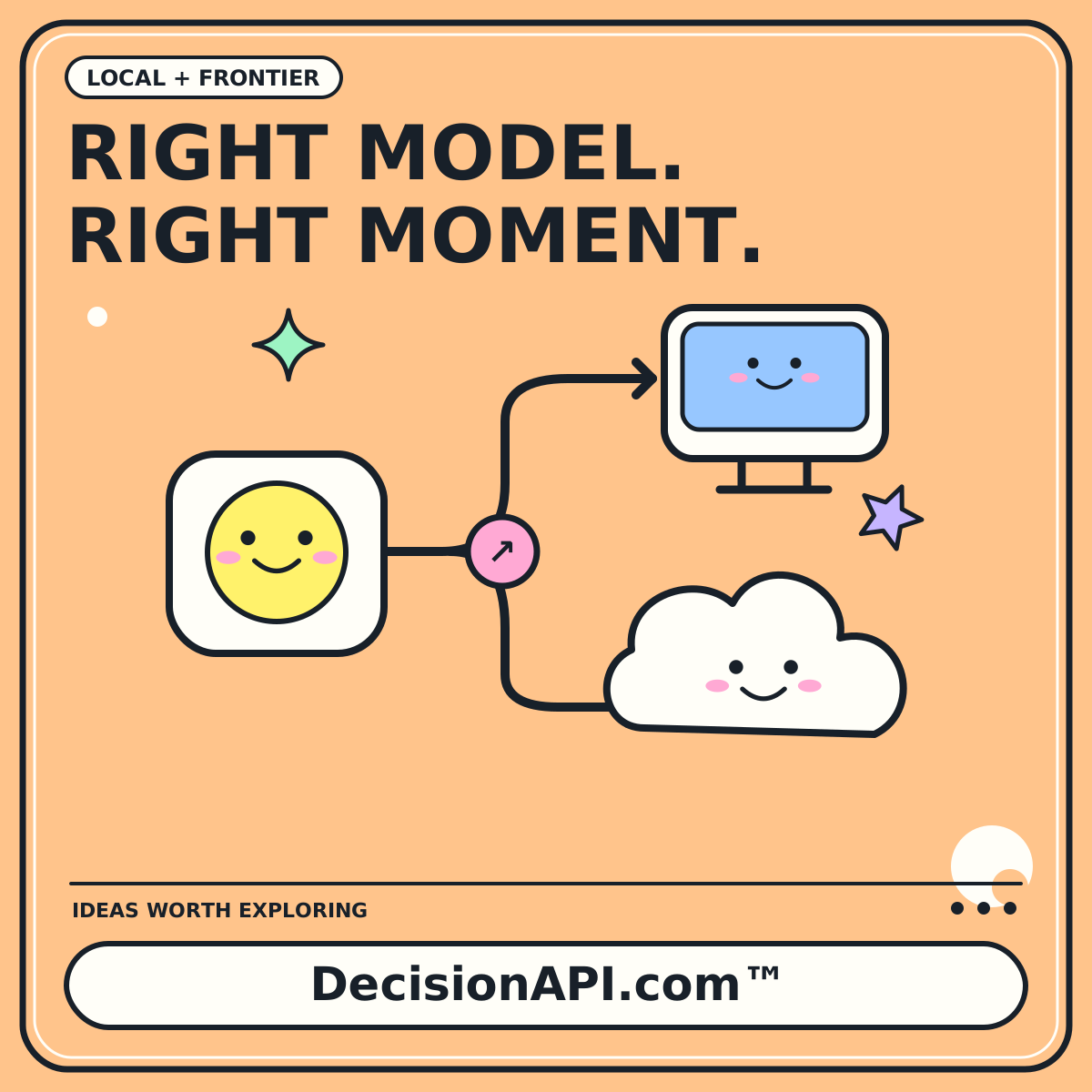
A local model can be useful when the task is narrow, the hardware is available, or evidence should remain within a controlled environment. A remotely hosted frontier model may be appropriate when difficult interpretation justifies its additional cost and network dependency.
This is already more than a theoretical interface pattern. Ollama's Decision documentation describes locally available System One requests for classification, yes/no questions, and scoring. The supported model and runtime still need to fit the workload.
A shared application contract can hide differences between these implementations from callers. It should not hide them from operators. Record which model handled the request, why it was eligible, and whether another stage was needed.
The useful comparison is complete workflow performance. A local first pass can be economical when it resolves routine cases accurately. It can be counterproductive if it adds delay before nearly every request is escalated. The model routing guide explains how to measure that tradeoff without assuming that one deployment style always wins.
Premium decision endpoints need a concrete promise
An application may pay more for a decision endpoint when the premium buys something operationally valuable: stronger performance on difficult cases, predictable service levels, appropriate data controls, or lower integration effort. A large model name alone does not establish that value.
A useful commercial promise also specifies what happens when the endpoint is unavailable or declines a request. Reliability includes graceful continuation of the user's task, not just an impressive answer under ideal conditions.
Providers may package those benefits differently. Some may sell specialized models, others managed workflows, and others domain-specific services that include data and policy. Several approaches can coexist because applications have different needs and consequences.
For builders, the immediate opportunity is to establish a useful decision contract and a representative evaluation set. Start with one recurring point of friction. Measure whether the new service improves the process, then expand where the evidence supports it.
Decision APIs could become ordinary infrastructure precisely because most users will not need to think about them. Their experience will be a more relevant next step, a clearer explanation, or less repetitive work. Our Decision API foundations guide starts with the concrete design choices that make that future worth building.